What Are Four Physical Properties Used to Describe a Liquid
7 Which term best describe the properties of a gas. Certain characteristics are used only to describe the physical properties of liquids.

Pin On Teaching Learning Kids
Brittleness - tendency of a material to break under stress.

. The molecules can not squeezed closer to one another. Absorption physical - absorption between two forms of matter. Albedo - reflecting power of a surface.
We can observe some physical properties such as density and color without changing the physical state of the matter observed. Melting point is the temperature at which a solid is converted to a liquid. The law of conservation of mass applies to chemical changes equals the mass of all of the substances that remain after the change.
6 What is the major defining property of gasses quizlet. Four distinctive properties which can be used to describe the liquids are critical temperature critical pressure surface tension and viscosity. In a liquid atoms are close together but not in a fixed arrangement.
The physical properties of water that are used for its measurement for example the absorption of wave motion or magnetic energy or the conduction of electricity require separation of water from compounds that may interfere with the measurement Table 2. List four physical properties you could use to describe a liquid. Liquids are almost incompressible.
Intermolecular forces are the forces between neighboring molecules. A liquid with high viscosity is very thick a property that tends to increase. The viscosity of a liquid is a measure of its resistance to flow.
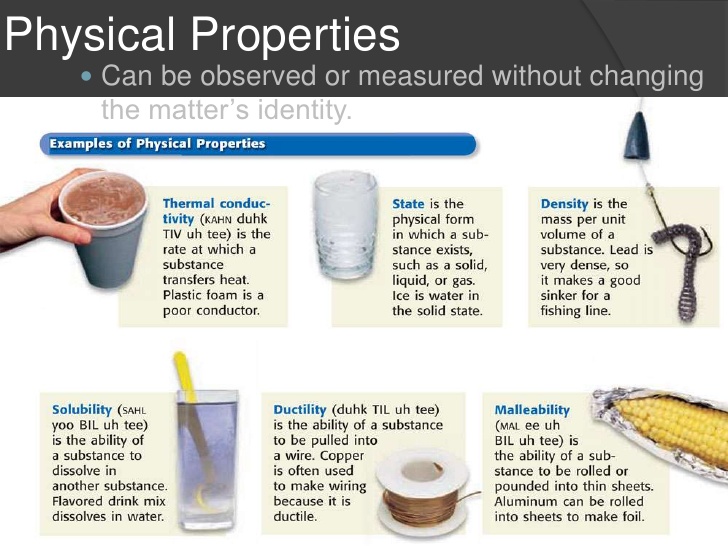
The physical properties of liquids include a large number of characteristics. All liquids and solids have a tendency to evaporate or sublime into a gaseous form and all gases have a tendency to condense back to their liquid or solid form. Physical properties of matter include color hardness malleability solubility electrical conductivity density freezing points melting points and boiling points.
Describe why flammability is a chemical property rather than a physical property. Liquids flow because the intermolecular forces between molecules are weak enough to allow the molecules to move around relative to one another. Liquids share some properties with solids both are considered condensed matter and are relatively incompressible and some with gases such as their ability to flow and take the shape of their container.
Gas is made up of atoms that are separate. However unlike solid liquid a gas has no fixed shape and volume. Intensive and Extensive Physical Properties.
Familiar examples of physical properties include density color hardness melting and boiling points and electrical conductivity. Water gasoline and other liquids that flow freely have a low viscosity. Explain how the law of conservation of mass applies to a chemical changes.
Honey syrup motor oil and other liquids that do not flow freely like those shown in have higher viscosities. Examples of extensive properties include size mass and volume. Water gasoline and other liquids that flow freely have a low viscosity.
Examples of chemical properties include flammability observed from combustion reactivity measured by readiness to participate in a reaction and toxicity demonstrated by exposing an organism to a chemical. We can measure viscosity by measuring the rate at which a metal ball falls through a liquid the ball falls more slowly. Liquid is distinguished by its malleable shape is able to form into the shape of its container but constant volume.
Solid liquid and gas. Boiling point melting point color density. 3 What are the four physical properties of gases.
Absorption of electromagnetism - the way a photons energy is taken up by matter. Angular momentum - the amount of rotation of an object. Extensive physical properties depend on the amount of matter in the sample.
Melting point and freezing points thus occur at the same temperature. The three states of matter are. Examples of intensive properties include boiling point state of matter and density.
Appearance texture color odor melting point boiling point density solubility polarity and many others. There is another way of condensing a gas to form a liquid however which involves raising the pressure on the gas. The molecules does not have lot of space between them.
A number of properties of liquids such as cohesion and adhesion are influenced by the intermolecular forces within the liquid itself. The viscosity of a liquid is a measure of its resistance to flow. In liquids molecules are pretty close to each other.
4 What are properties of gas. The four physical properties that describe a liquid is when it freezes boils evaporates or condenses. Examples of Physical Properties of Matter - Comprehensive List.
Critical Temperature and Critical Pressure. The obvious way to turn a gas into a liquid is to cool it to a temperature below its boiling point. Odor and color are two simple examples.
8 What are the 6 properties of gas. Honey syrup motor oil and other liquids that do not flow freely like those shown in Figure 1 have higher viscosities. The melting point and boiling point are related to changes of the state of matter.
Freezing point is the temperature at which a liquid changes to solid. 2 What are three physical properties of gases quizlet. Intensive physical properties do not depend on the samples size or mass.
Liquids boil at the temperature at which the vapor pressure is equal to the pressure on the liquid from its surroundings. 5 What are the 3 main properties of matter. All liquids show the following characteristics.
A physical property is a characteristic of matter that is not associated with a change in its chemical composition. Helmenstine Anne Marie PhD. Usually water is separated by a phase transition from a liquid or solid to a gas.
Viscosity When the intermolecular forces of attraction are strong within a liquid there is a larger viscosity. We can measure viscosity by measuring the rate at which a metal ball falls through a liquid the ball falls more slowly. Viscosity or thickness for instance describes the resistance of a liquid to the tendency to flow.

The Nature Of Matter The Properties Of Matter What Is Matter Easier To Describe Than To Define It Is The Stuf Properties Of Matter Matter Unit Define Matter
1 4 Classification And Properties Of Matter Chemistry Libretexts

Teachers Notebook Matter Science Science Lessons Teaching Science

Venn Diagram Venn Diagram Science Lessons Science

Matter Quiz Vocabulary True And False Fill In The Blank Matter Science Science Lessons Middle School Science Experiments

States Of Matter Posters Matter Solids Liquids And Gases Matter Science States Of Matter Second Grade Science

Properties Of Solids Liquids Gases Compared Teachoo Science

Snowy Science Four Frosty Experiments Scholastic Com Matter Science Teaching Science Fourth Grade Science

Solids Liquids Gases 3 Types Of Matter Graphic Organizer Graphic Organizers Matter Science Science Lessons

Difference Between Solid Liquid And Gas In Tabular Form States Of Matter Simplified Solid Liquid Gas States Of Matter Intermolecular Force

Properties Of Solids Liquids Gases Compared Teachoo Science
Matter Observe Physical Properties And Changes Student Teaching Resources Teaching Science Physical Properties Of Matter

Properties Of Matter Properties Of Matter Matter Science Physical And Chemical Properties

Pin On I Heart Kindergarten

Classification Of Matter Quiz Physics Classroom Matter Unit Quiz Questions And Answers

Scientific Saturdays States Of Matter Brochures States Of Matter Middle School Science Experiments School Science Experiments

Pin On Science

Writing Like A Scientist Properties Of Liquids Chart 1st Grade Matter Science Kindergarten Science Activities 1st Grade Science

Matter Solid Liquid Or Gas Properties Of Matter Gas Matter


Comments
Post a Comment